

Supplements for Low Estrogen: Evidence, Safety, and What to Consider
Could supplements for low estrogen help with symptoms, or might they distract from finding out what’s causing them? Hot flashes, changes in sleep, and vaginal discomfort can occur during hormonal transitions, but they don’t confirm low estrogen on their own. That uncertainty can make conflicting supplement claims difficult to assess.
It’s reasonable to look for options, but a supplement isn’t the same as estrogen therapy and shouldn’t replace a diagnosis or individualized care. Ingredients marketed as phytoestrogens may affect the body differently from estrogen, and evidence can vary by ingredient and intended use.
This article explains what low estrogen can mean, why symptoms alone may not establish a diagnosis, and how to assess supplement evidence, labels, potential side effects, and interactions. You’ll also find practical points to discuss with a qualified healthcare professional, especially if symptoms are persistent, concerning, or could have another cause. The goal is to help you consider supplements as possible nutritional support, not as a substitute for identifying the cause of symptoms or getting personalized medical guidance.
Key Takeaways
- Estrogen levels can change during perimenopause and menopause, but symptoms alone can’t establish the cause.
- When evaluating supplements for low estrogen, look for evidence tied to the specific ingredients, population, and outcome, rather than broad hormone claims.
- Compare labels for ingredient identity, amount per serving, directions, and stated cautions before choosing a product.
- Prepare a record of your concerns, current supplements, and medications to support a more informed discussion with a qualified healthcare professional.
- Consider a menopause multivitamin, including Evabiotic Menopause Relief Multivitamins (60 Capsules), by checking its current label and fit for your needs, not as a proven way to raise estrogen.
What Low Estrogen Can Mean, and Why Symptoms Alone Are Not Enough
Estrogen is a group of hormones involved in reproductive health and other body functions. Estradiol is one form of estrogen and is particularly relevant during the reproductive years. The phrase “low estrogen” can refer to a measured hormone level, but people may also use it to describe a suspicion based on symptoms. These are not the same thing: symptoms can be a reason to seek context, but they don’t confirm a hormone level.
This distinction matters when considering supplements for low estrogen. Changes in sleep, mood, or body temperature may occur alongside hormonal shifts, but they can also have other explanations. A symptom alone cannot show whether estrogen is low or identify why a change is happening.
How estrogen changes may relate to the menopause transition
Perimenopause, the transition leading up to menopause, can involve changing hormone patterns. After menopause, ovarian estrogen production is generally lower than before the transition, but experiences vary. There is no single symptom pattern that confirms a particular hormone level. For background on plant-derived compounds sometimes discussed in supplement claims, see this overview of phytoestrogens. The name does not mean these compounds are the same as the body’s estrogen.
Hot flashes, disrupted sleep, and mood changes may occur during the menopause transition, but estrogen isn’t necessarily the only factor. Health conditions, medicines, stress, and other changes can also be relevant. Avoid assuming every new or persistent symptom is caused by hormones.
When symptoms merit a clinical conversation
Consider discussing symptoms with a clinician if they’re persistent, severe, changing, or concerning to you. Describe what you’ve noticed, when it began, and how it affects daily life. A simple record of when symptoms occur and any changes over time can help you explain your concerns. Bring a list of medicines and supplements as well.
A clinician can consider symptoms alongside your health history and decide whether tests may be useful. The choice and interpretation of tests depend on individual circumstances, so a single result may not explain the full picture. Rather than trying to diagnose low estrogen from symptoms or a supplement label, use the discussion to clarify possible causes and which options may be appropriate for you.
How to Assess Supplements for Low Estrogen Claims
Before choosing supplements for low estrogen, separate two different ideas: supplying nutrients that contribute to general nutritional adequacy and changing hormone levels. A product’s vitamins or minerals may be relevant to someone’s diet, but their presence doesn’t establish that the product raises estrogen. A menopause-focused name or broad promise to “balance hormones” isn’t evidence of a specific effect either.
A supplement claim needs evidence for the specific ingredient, the people studied, and the outcome being promised. A plausible biological explanation is not proof that a product will restore hormones, relieve symptoms, or treat a condition. Look for evidence that directly supports the precise claim, rather than relying on general language about hormone support.
What research can and cannot establish
Research findings have different levels of relevance. A proposed biological mechanism can suggest how an ingredient might act, but it doesn’t show that people experience a meaningful benefit. Early studies may raise useful questions, while stronger conclusions require evidence that directly examines the relevant population and outcome. Even then, findings may not apply to everyone.
When reviewing a study, check its design, participants, ingredient form and amount, outcome measured, and stated limitations. A study of one isolated ingredient can’t establish the effects of a finished supplement with a different or unverified formula. Match the evidence to the claim: research on one outcome doesn’t prove a different outcome.
Phytoestrogens and other commonly discussed ingredients
Phytoestrogens are plant-derived compounds discussed in relation to estrogen, but the term alone doesn’t show that an ingredient acts like prescribed estrogen or has the same effects in every person. Evaluate claims ingredient by ingredient. For example, the National Center for Complementary and Integrative Health reviews research and safety considerations for black cohosh in its overview of Black Cohosh for Menopause Symptoms. A familiar ingredient name is a reason to review the evidence, not assume a benefit.
For any product, verify the current label, full ingredient list, serving directions, and cautions before drawing conclusions. Evabiotic’s Menopause Relief Multivitamins can be assessed in the same way: compare the label with your needs and discuss questions with a qualified clinician. A supplement may be considered for nutritional support, but it isn’t a substitute for diagnosis or individualized care.
How to Compare Supplements for Low Estrogen Without Overreading the Label
A supplement label can help you understand what a product contains and how it is intended to be used. It can’t, by itself, establish that the product raises estrogen or “restores” hormonal balance. Treat phrases such as “natural hormone support” as claims to investigate, not proof of an effect. The word natural also doesn’t establish that a product is safe, effective, or suitable for you.
Use the same criteria to compare supplements for low estrogen. Check each product’s current label before making product-specific decisions, and don’t infer effects from the product name or front-of-package claims.
Read the supplement facts and directions carefully
Start with the serving size, amount of each listed ingredient per serving, full ingredient list, directions, and any stated warnings or cautions. Don’t infer an ingredient’s amount from its prominence on the front of the package. Compare label details with your health circumstances, other supplements, and medicines. If information is missing or unclear, ask the manufacturer or a qualified healthcare professional rather than guessing.
| What to compare | What to look for | What it can tell you |
|---|---|---|
| Ingredient identity | The specific ingredient names and complete list | Whether the label clearly identifies what’s included |
| Amount per serving | The stated amount for each ingredient and serving size | How much the label says is provided per serving, not whether it will produce a particular effect |
| Directions | Serving instructions and any use guidance | How the manufacturer indicates the product should be used |
| Stated cautions | Warnings, restrictions, or other cautions on the label | Points to review in light of your health history and medicines |
Check evidence, quality information, and potential interactions
After reviewing the label, look for evidence that matches the specific ingredient, amount, population studied, and outcome being claimed. General research about an ingredient doesn’t automatically establish the effect of a particular finished product. A statement about quality or manufacturing may describe a process, but it isn’t proof of a specific health outcome.
Ask a healthcare professional or pharmacist whether a supplement may interact with your medicines or other products. Before relying on claims about testing, manufacturing standards, or certification, verify that the statement applies to the product and is supported by clear documentation. For a menopause multivitamin such as Evabiotic’s, check the current product label and ingredient information before assessing fit. A label can inform your questions, but it can’t replace individualized guidance or confirm a diagnosis.
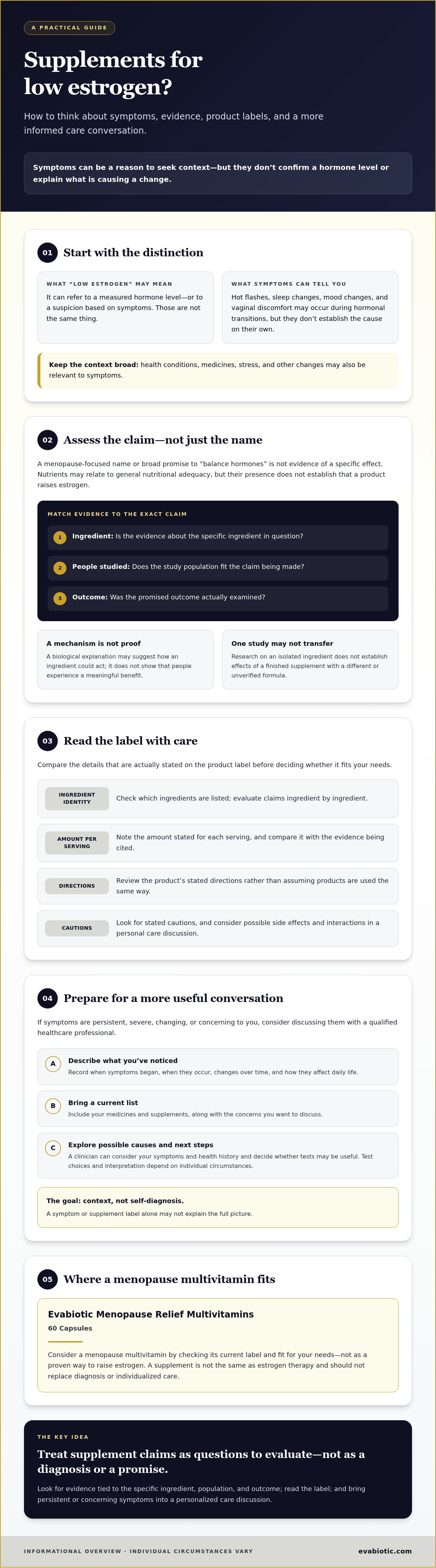
A Safer Step-by-Step Plan Before Trying Supplements for Low Estrogen
A measured approach can help you make decisions without treating symptoms as a diagnosis or relying on supplement marketing. Before considering supplements for low estrogen, organize what you’ve noticed, review what you already take, and seek individualized advice when appropriate.
- Record your concerns. Note the symptoms, when they occur, how long they’ve been present, and whether they affect daily activities. Use the record to describe your experience, not to diagnose a hormone deficiency.
- Review current products. Gather labels for medicines, vitamins, herbs, and other supplements, including serving directions and cautions. This gives your clinician or pharmacist specific information to review.
- Arrange a discussion. Share your notes and product labels with a clinician or pharmacist, who can consider your health history and medicines when discussing whether a supplement may be suitable.
Prepare for a clinician or pharmacist discussion
Bring a concise list of questions, such as whether a symptom needs assessment, whether a proposed product may interact with a medicine, and what evidence supports its stated purpose. Individual advice is especially relevant if you have a health condition or take prescription or over-the-counter medicines. A clinician can decide whether further assessment, including testing, is appropriate for your circumstances.
For additional background on menopause multivitamins and hormonal support, see the guide Menopause Relief Multivitamins: A Clinical Guide to Systemic Hormonal Support. Treat educational material as preparation for a conversation, not a substitute for care tailored to your health history.
Know when not to rely on a supplement alone
Don’t let a supplement trial delay professional assessment of symptoms that persist, feel severe, or concern you. A symptom checklist or online article cannot determine the cause or confirm a hormone level. If you’re experiencing hot flashes, the guide Natural Remedies for Hot Flashes: A Clinical Roundup of Vasomotor Support (2026) may offer context, but it shouldn’t replace individualized advice.
Don’t stop, replace, or change prescribed treatment based on a supplement label or marketing claim. Discuss any proposed change with the clinician responsible for your care. If you’re assessing a menopause multivitamin as one part of your plan, review Evabiotic Menopause Relief Multivitamins and check its current label against your personal needs.
Where a Menopause Multivitamin Fits in a Low Estrogen Support Plan
A menopause multivitamin may be one product to consider for general nutritional support, depending on its label and your circumstances. It shouldn’t be treated as a proven way to raise estrogen, restore hormonal balance, or address the cause of symptoms. Assess its role by reviewing what it contains, whether that fits your needs, and whether it’s suitable alongside your medicines and other supplements.
Evabiotic offers Evabiotic menopause relief multivitamins in a 60-capsule format, with individual purchase and subscription options. Those details describe the product and purchasing formats, not clinical outcomes. Review the current product label for the full ingredient list, serving directions, and cautions before deciding whether it may fit your routine.
Questions to ask before choosing a menopause multivitamin
- Does the current label fit your nutritional needs? Consider the listed ingredients and amounts in the context of your diet and health history. A menopause-focused label alone doesn’t establish that a product addresses low estrogen.
- Have you reviewed it alongside medicines and other supplements? A clinician or pharmacist can help assess whether ingredients may be suitable for your circumstances and whether potential interactions warrant attention.
- Does the format fit your preferences and routine? Consider whether capsules suit you and whether the directions are practical for your day-to-day habits. Check the current label rather than assuming use details.
These questions can help distinguish a product that may fit a personal nutrition plan from one chosen in the hope of changing hormone levels. If you’re uncertain about symptoms or suitability, discuss your concerns with a qualified healthcare professional before starting a supplement.
Review the product information with care
Compare the label with your needs, and don’t infer ingredients, amounts, or effects from the product name. The current information is the appropriate basis for evaluating what the product contains. A healthcare professional can help place that information in the context of your health history and current medicines. A multivitamin is not a substitute for diagnosis or individualized medical care.
If you’d like to examine the capsule format and available purchase options, review the Evabiotic menopause multivitamin and its current label at your own pace. Use that information to support an informed conversation, not as a promise of hormone or symptom outcomes.
Choose Your Next Step With Care
Symptoms can prompt questions about estrogen, but they don’t confirm a hormone level or its cause. Before considering supplements for low estrogen, assess claims against evidence for the specific ingredients and outcomes. Review the current label rather than relying on broad promises about hormone balance.
A supplement may be considered for nutritional support, but it isn’t a substitute for diagnosis or individualized medical advice. Recording your concerns and reviewing medicines and other products with a qualified healthcare professional can help you make a more informed decision about personal suitability.
Evabiotic Menopause Relief Multivitamins are offered in a 60-capsule format, with individual purchase and subscription options. Review the current product information to understand what’s listed, then consider whether it fits your needs and routine. Review Evabiotic Menopause Relief Multivitamins.
Thoughtful questions and personalized guidance can help you move forward with greater clarity. To assess Evabiotic’s capsule multivitamin and its available purchase options, review the current product information.
Frequently Asked Questions
Can supplements increase estrogen levels?
Some supplements are marketed as ways to affect estrogen, but assess each claim against evidence for the specific ingredient and measured outcome. Nutrients that support general nutritional adequacy aren’t automatically estrogen-raising ingredients. Plant-derived compounds called phytoestrogens aren’t the same as the body’s estrogen, and their effects may differ. Don’t assume a supplement restores hormones or treats symptoms. Review the evidence and discuss personal suitability with a qualified healthcare professional.
What vitamins should I take for low estrogen?
There isn’t one vitamin recommendation that applies to everyone with suspected low estrogen. A multivitamin may be relevant to general nutritional needs, but its ingredients don’t establish that it can raise estrogen. Before choosing supplements for low estrogen, consider your diet, health history, medicines, and the product’s current label. A clinician or pharmacist can help you assess whether a particular nutrient or product may be suitable for you.
How do I know if my estrogen is low?
Symptoms alone can’t confirm that estrogen is low because changes in sleep, mood, or body temperature may have more than one cause. A clinician can consider what you’re experiencing alongside your health history and decide whether testing may be appropriate. Test selection and interpretation depend on individual circumstances. Record when symptoms occur, how long they’ve been present, and any medicines or supplements you use to support a more useful discussion.
Are phytoestrogen supplements safe for everyone?
No supplement is automatically suitable for everyone, including one containing phytoestrogens. Safety may depend on the specific ingredient, product, health circumstances, and medicines or other supplements a person uses. “Plant-derived” or “natural” doesn’t by itself establish safety or effectiveness. Check the full ingredient list and cautions, then ask a clinician or pharmacist about personal suitability and potential interactions, especially if you have a health condition or take medication.
Can supplements replace estrogen therapy?
Supplements shouldn’t be assumed to replace prescribed estrogen therapy. They may contain different ingredients and have different intended uses, and supplement claims don’t establish equivalent effects. Don’t stop, replace, or change prescribed treatment based on product marketing. Discuss questions about treatment options or changes with the clinician responsible for your care. A supplement may be considered for nutritional support, but it isn’t a substitute for diagnosis or individualized medical guidance.
What should I check before choosing a menopause multivitamin?
Review the current label for serving size, ingredient names and amounts, directions, and stated cautions. Consider whether the product fits your nutritional needs, health circumstances, and routine, and ask a clinician or pharmacist to review it alongside your medicines and other supplements. Evabiotic offers Menopause Relief Multivitamins in a 60-capsule format, with individual purchase and subscription options. Check its current product information rather than assuming ingredients or effects from its name.
Disclaimer
*These statements have not been evaluated by the Food and Drug Administration. This product is not intended to diagnose, treat, cure or prevent any disease. The views and nutritional advice expressed by AlphaHealth+ Nutrition are not intended for the purpose of providing medical advice. Please always consult your health care provider if you are taking any medications or have any medical conditions. Individual results may vary.