

7 Natural Menopause Treatments That Really Work: What Evidence Can, and Cannot, Tell You
A “natural” label doesn’t tell you whether a menopause approach is effective, safe for you, or supported by strong research. If you’re searching for 7 natural menopause treatments that really work, conflicting claims can make it difficult to separate promising options from overstated promises.
It’s reasonable to prefer nonprescription approaches or to have questions about hormone therapy. The evidence isn’t equally strong for every option: some may help with particular symptoms, while others remain uncertain. Supplements also deserve careful review because ingredients can interact with medicines or may not suit everyone.
This guide compares seven nonprescription approaches, explains what research can and can’t tell you, and considers how each may fit different symptoms and preferences. You’ll also find practical points to weigh before trying a supplement, including checking its current label and discussing personal health concerns with a qualified healthcare professional. The aim is a clearer, safer next step, not a one-size-fits-all answer.
Key Takeaways
- Use the evidence, intended outcome, and safety considerations to assess which of the 7 natural menopause treatments that really work may be relevant to your main concern.
- CBT, clinical hypnosis, and exercise are distinct approaches. Consider what each is intended to address rather than treating them as interchangeable.
- Sleep habits and mindfulness may support wellbeing, while evidence for nutrition and supplements can vary. Check the limitations and safety questions for each.
- Choose one approach at a time where practical, note changes in your symptoms, and seek individualized advice when health conditions or medications may affect suitability.
- A menopause multivitamin is an optional supplement category, not a proven treatment for every symptom. Review the current label and discuss suitability with a qualified professional.
What Does “Really Work” Mean for Natural Menopause Treatments?
“Natural” can describe several different approaches, not one treatment category. It may refer to behavioral strategies, lifestyle practices, or nonprescription products such as supplements. These options also have different aims: cognitive behavioral therapy may be studied for symptom-related distress, while a supplement may be considered for nutritional reasons. Neither label alone tells you whether an approach is effective or suitable for a particular person.
Menopause involves changes that can affect symptoms and health in different ways. A general Menopause overview can help explain its stages and physiology, but deciding what to try requires a closer look at the specific symptom and evidence for the approach. “Works” should mean a measurable, relevant benefit, not a promise to prevent or resolve every menopause-related concern.
How to judge evidence without expecting a cure
Give more weight to current clinical guidelines and systematic reviews than to testimonials or marketing language. Look at what researchers measured, such as symptom frequency, sleep quality, or how much symptoms interfere with daily life. A positive result for one outcome doesn’t establish benefits for others, and an average study result can’t predict an individual response. Assess the strength and limitations of the evidence separately for each approach.
Research also varies in quality, design, and the people included. Before relying on a finding, check whether it comes from a credible, current source and applies to the approach you’re considering. The phrase 7 natural menopause treatments that really work is a useful search, not a guarantee that all seven have equally strong evidence or will work for every reader.
Which menopause symptoms need a tailored approach?
Start by naming your main concern. Vasomotor symptoms, such as hot flashes and night sweats, are different from sleep disruption or mood concerns, and general health goals may call for a different discussion. An approach studied for hot-flash distress, for example, shouldn’t be assumed to improve sleep or address another symptom. Matching the evidence to the outcome matters.
Track what you hope to change and whether it shifts over time. If symptoms are new, severe, persistent, or unexplained, seek advice from a healthcare professional rather than assuming menopause is the only cause. Individual responses vary, and a clinician can help consider your health needs, possible causes, and whether a nonprescription approach is appropriate.
Natural Menopause Treatments 1 to 3: CBT, Clinical Hypnosis, and Exercise
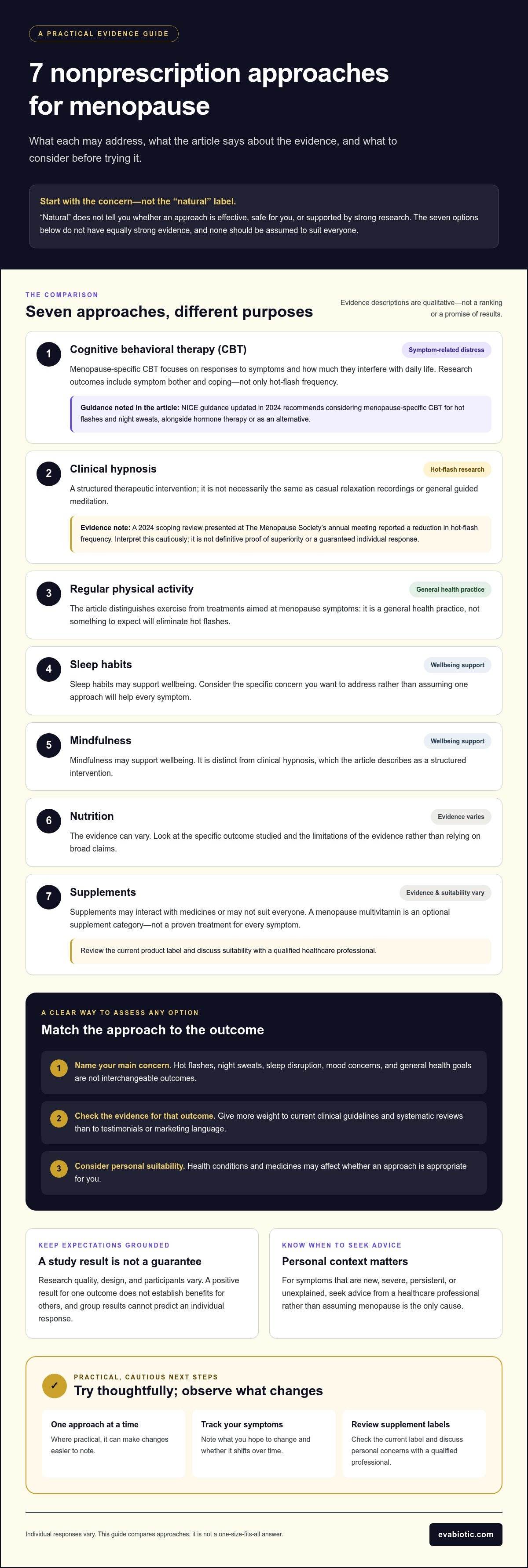
Cognitive behavioral therapy (CBT), clinical hypnosis, and physical activity serve different purposes. Menopause-specific CBT and clinical hypnosis have been studied for their relationship to symptoms such as hot flashes and night sweats. Exercise is better viewed as a general health practice, not a treatment that can be expected to eliminate hot flashes. The National Institute on Aging provides background on menopause symptoms and care options.
1. Cognitive behavioral therapy for symptom-related distress
Menopause-specific CBT is structured psychological support. It doesn’t suggest that symptoms are imagined; it focuses on how a person responds to symptoms and how much they interfere with daily life. NICE guidance updated in 2024 recommends considering menopause-specific CBT for hot flashes and night sweats, either alongside hormone therapy or as an alternative. Research has also examined symptom bother and coping, outcomes that differ from reducing the number of hot flashes themselves.
Study results describe groups, not a guaranteed response for an individual. If CBT seems relevant, ask a healthcare professional about suitable provider options, access, and whether the approach matches your main concern.
2 To 3. Clinical hypnosis and regular physical activity
Clinical hypnosis is a structured intervention delivered for a therapeutic purpose. It isn’t necessarily equivalent to casual relaxation recordings or general guided meditation. A 2024 scoping review presented at The Menopause Society’s annual meeting reported a reduction in hot-flash frequency with clinical hypnosis. Because this was a scoping review, interpret the finding cautiously. It isn’t a promise or definitive proof that hypnosis is superior to CBT for every person.
In short, CBT and clinical hypnosis are symptom-focused therapies with evidence related to hot-flash impact or frequency. Exercise is a general health practice and shouldn’t be treated as interchangeable with them. When comparing the 7 natural menopause treatments that really work, ask which outcome each approach may support and how well the evidence fits your situation.
If you’re separately considering a supplement, you can review the listing for Menopause Relief Multivitamins and check the current label with a qualified professional for suitability.
Natural Menopause Treatments 4 to 7: Sleep Habits, Mindfulness, Nutrition, and Supplements
These approaches may support sleep, stress management, or general health, but they aren’t interchangeable or guaranteed remedies. The table summarizes their intended purpose and key questions to consider before trying them.
| Approach | Intended purpose | Evidence limitations | Key safety question |
|---|---|---|---|
| Sleep habits | Support a regular, comfortable sleep routine | Habits may support sleep, but may not resolve insomnia or night sweats | Could symptoms or another health issue be disrupting sleep? |
| Mindfulness | Practice attention and stress management | Research suggests possible benefits for some mood-related outcomes, not every menopause symptom | Is this practice comfortable and suitable for me? |
| Nutrition | Support overall health with balanced, individualized eating | No single food or restrictive diet should be assumed to cure menopause symptoms | Would dietary changes fit my health needs and medication plan? |
| Supplements | Address a specific nutritional or personal goal | Evidence varies by ingredient and product; “natural” doesn’t establish effectiveness or safety | Could ingredients interact with medicines or health conditions? |
4 To 6. Sleep routines, mindfulness, and nutrition
A steady wake time, a calming wind-down routine, and a cool, comfortable bedroom are practical starting points for sleep. These habits may create more supportive conditions for rest, but they can’t be relied on to stop night sweats or resolve persistent insomnia. If sleep disruption continues, consider discussing possible causes and options with a healthcare professional.
Mindfulness can include practices such as guided breathing or a brief body scan. A 2024 systematic review of 19 trials reported decreases in anxiety, depressive symptoms, and perceived stress among menopausal participants. Those findings relate to particular outcomes; they don’t show that mindfulness will relieve every symptom or have the same effect for each person.
For nutrition, favor an approach that meets your individual needs rather than a cure-all plan. A balanced eating pattern can support general health, but claims that a specific food or restrictive diet treats menopause symptoms need appropriate evidence. A registered dietitian or healthcare professional can help tailor dietary changes, particularly if you have a medical condition or take medication.
7. Supplements: assess the label, evidence, and safety
Before choosing a supplement, check the specific product’s ingredients, amounts, directions, and warnings. Then look for credible evidence for those ingredients and the outcome you hope to address. Research on one ingredient or formulation doesn’t automatically apply to another product. The FDA doesn’t evaluate every dietary supplement for safety and effectiveness before it reaches the market, so a “natural” label isn’t a substitute for careful review.
Ask a clinician or pharmacist to review a supplement if you take medicines, have a health condition, or are considering combining products. When comparing the 7 natural menopause treatments that really work, focus on the intended outcome, limits of the evidence, and your own safety needs.
How to Choose and Try Natural Menopause Treatments Safely
A clear plan can make it easier to assess what may help without treating every option as a cure-all. Start with the concern affecting your daily life most, then match an approach to its intended purpose and the evidence for that outcome. The goal is a considered trial, not a diagnosis or a substitute for individualized care.
A practical, symptom-led plan
Use this sequence to make your next step more manageable:
- Identify the main concern. Note whether hot flashes, disrupted sleep, mood changes, or another issue is having the greatest impact.
- Check the evidence. Look for clinical guidance or reviews that study the specific approach for the outcome you want to address. Popularity alone doesn’t show that a treatment fits your needs.
- Assess safety. Consider your health history, current medicines, and any relevant product warnings. Ask a qualified healthcare professional about uncertainties before starting, especially with supplements.
- Review your experience. Where practical, try one change at a time so you can better understand what may be associated with a change in symptoms.
A simple record can help you discuss patterns with a clinician. Note the symptom, its effect on your day, and relevant context such as sleep disruption or changes in routine. This information may support a more focused conversation, but tracking alone can’t identify the cause of a symptom or diagnose a condition.
When to seek professional advice
Arrange medical advice for symptoms that are new, severe, unexplained, persistent, or disruptive to daily life. A clinician can help consider whether menopause may be involved and discuss options in light of your health needs. This matters even if you prefer nonprescription approaches; seeking advice doesn’t commit you to a particular treatment.
Supplement safety depends on both the person and the specific product. Ingredients, amounts, medicines, health conditions, and individual history can all be relevant. If you take medication, manage a health condition, or plan to combine supplements, ask a clinician or pharmacist to review the product and its current label before use.
Use the same careful process when comparing the 7 natural menopause treatments that really work: focus on the intended outcome, evidence, and personal suitability rather than expecting one option to address everything. If you’re evaluating a multivitamin as a supplement option, review the Menopause Relief Multivitamins details and discuss the current label with a qualified professional to assess whether it may suit your needs.
Where a Menopause Multivitamin Fits: What to Check Before Choosing One
A menopause multivitamin is one optional supplement category to consider, not a proven treatment for every menopause symptom. Whether a particular product suits you depends on its formulation, the evidence for its ingredients, and your health circumstances. A product’s name or broad menopause-focused marketing language can’t answer those questions on its own.
Questions to ask before selecting a menopause supplement
Start with the product’s current label. Review the complete Supplement Facts panel, ingredient amounts, directions, and warnings. Then assess whether there is credible evidence for the specific ingredients and the outcome you hope to support. Evidence about one ingredient or formulation may not apply to a different product, and general claims about menopause aren’t a substitute for product-specific information.
It’s also useful to consider what you already take. Some ingredients may interact with medicines or may be unsuitable for certain health conditions. Ask a healthcare professional or pharmacist to review the label if you take medication, manage a health condition, or are unsure whether the product is appropriate. Don’t assume “natural” means effective or risk-free.
Consider Evabiotic only if the format and approach fit
Evabiotic lists Menopause Relief Multivitamins in a capsule format, with 60 capsules. An optional recurring subscription is available as a purchasing format. These details describe the listed product and ordering option; they don’t establish the formula’s ingredients, evidence, or effects. Check the current product label and discuss suitability with a qualified professional before deciding whether it fits your needs.
Use the same evidence-led approach you’ve applied to the 7 natural menopause treatments that really work: identify your goal, check relevant evidence, and consider safety before choosing an option. A multivitamin may be worth evaluating if the category and format suit your preferences, but it shouldn’t be treated as a substitute for individualized medical advice or care.
If you’d like to review the listed product details, see Review Evabiotic menopause multivitamins. Take time to check the current label and raise any questions with a healthcare professional or pharmacist before use.
Choose a Next Step That Fits Your Needs
The 7 natural menopause treatments that really work aren’t a single solution for everyone. Evidence varies by symptom and approach, and a strategy that may support sleep or stress won’t necessarily address hot flashes. Start with the concern affecting you most, weigh the evidence and safety, and seek individualized advice for symptoms that are persistent, severe, or unexplained.
Supplements call for the same careful review. Check the current label and discuss ingredients with a qualified healthcare professional or pharmacist, especially if you take medicines or manage a health condition. A multivitamin is an optional supplement category, not a proven treatment for every menopause symptom.
Evabiotic lists a menopause multivitamin in a 60-capsule format, with an optional recurring subscription. Review the label and current subscription terms before deciding whether this option fits your preferences, and ask a qualified professional about suitability. Review Evabiotic menopause multivitamins.
Take one informed step at a time. To review Evabiotic’s menopause multivitamin, check the current product label and discuss suitability with a qualified healthcare professional or pharmacist.
Frequently Asked Questions
Which natural menopause treatments have the strongest evidence?
Evidence depends on the symptom and outcome being studied, so there isn’t one option that ranks strongest for everyone. NICE’s 2024 guidance recommends considering menopause-specific cognitive behavioral therapy (CBT) for hot flashes and night sweats, alongside or instead of hormone therapy. Clinical hypnosis has promising findings, but its evidence should be interpreted cautiously. The 7 natural menopause treatments that really work vary in research quality and purpose, so match the evidence to your main concern.
Can natural treatments replace hormone therapy?
Natural approaches shouldn’t be assumed to replace hormone therapy. CBT, sleep habits, mindfulness, exercise, nutrition, and supplements have different aims and evidence, and may not address the same symptoms or needs as medical treatment. If you’re considering hormone therapy, avoiding it, or using nonprescription options, discuss benefits, risks, and alternatives with a qualified healthcare professional. Treatment decisions are individual, and this article can’t determine which option is appropriate for you.
Are menopause supplements safe to take with medication?
Not necessarily. Supplement ingredients may interact with prescription or over-the-counter medicines, and suitability can depend on your health conditions and the specific product. Before starting one, share its complete label, including ingredient amounts and warnings, with a healthcare professional or pharmacist. This is especially relevant if you take several medicines or plan to combine supplements. Don’t assume a product is safe simply because its ingredients are described as natural.
How long do natural menopause treatments take to work?
There’s no single timeframe that applies to every approach or person. Study protocols and measured outcomes differ, and an individual response may not match a study average. Before trying an option, decide what change you’re looking for, such as less interference from hot flashes or a more consistent sleep routine. Track your experience and ask a healthcare professional when to review the approach, particularly if symptoms persist or worsen.
Can exercise help with menopause symptoms?
Exercise can support broader health goals, including fitness, strength, and mobility, but it shouldn’t be expected to eliminate hot flashes or night sweats. Choose an activity that fits your current ability, such as walking or adapted strength exercises, and build a routine that feels manageable. If you have a health condition, pain, or concerns about starting or changing activity, ask a healthcare professional for individualized guidance.
Does mindfulness stop hot flashes or night sweats?
No reliable promise can be made that mindfulness will stop hot flashes or night sweats. A 2024 systematic review of 19 trials reported decreases in anxiety, depressive symptoms, and perceived stress among menopausal participants. Those findings relate to specific outcomes and don’t establish that mindfulness addresses every symptom. Practices such as guided breathing may suit some people as stress-management support, but persistent or disruptive symptoms warrant a broader care discussion.
What should I check on a menopause multivitamin label?
Review the complete Supplement Facts panel, ingredient names and amounts, directions, and warnings. Then look for evidence relevant to the actual ingredients and the outcome you hope to support; broad menopause-focused marketing isn’t the same as product-specific evidence. A menopause multivitamin is an optional supplement category, not a proven treatment for every symptom. Ask a clinician or pharmacist to review the label if you take medicines or manage a health condition.
When should I talk to a doctor about menopause symptoms?
Seek medical advice for symptoms that are new, severe, unexplained, persistent, or interfering with daily life. A healthcare professional can help assess whether menopause may be contributing and discuss options in light of your medical history and preferences. Bring notes about what you’re experiencing, when it occurs, and how it affects you. This article offers general information, not a diagnosis or substitute for individualized care.
Disclaimer
*These statements have not been evaluated by the Food and Drug Administration. This product is not intended to diagnose, treat, cure or prevent any disease. The views and nutritional advice expressed by AlphaHealth+ Nutrition are not intended for the purpose of providing medical advice. Please always consult your health care provider if you are taking any medications or have any medical conditions. Individual results may vary.