

Best Multivitamin for Women Over 50: How to Choose in 2026
The multivitamin labeled for women over 50 may not be the best multivitamin for women over 50. An age-specific formula can be a useful starting point, but the right choice also depends on your diet, other supplements, health history, and medications. Labels can be difficult to compare when serving sizes, Daily Values, and overlapping ingredients obscure what you would actually be adding.
You can make the comparison more manageable by checking each product against the same criteria. This guide explains how to compare general and menopause-focused multivitamins, read key label details, and consider how your diet and health context may affect your needs. It also covers when to discuss a supplement with a healthcare professional, because supplements do not replace individualized care.
We’ll cover practical label-reading steps and common safety questions, including nutrient overlap and medication interactions. Evabiotic’s 60-capsule menopause relief multivitamin is one capsule option to consider if you’re looking for a menopause-focused formula.
Key Takeaways
- The best multivitamin for women over 50 depends on more than age. Consider your dietary pattern, current nutrient intake, and personal health context.
- Check the Supplement Facts panel for serving size, nutrient amounts, and percent Daily Value. Compare nutrients such as vitamin D, vitamin B12, and calcium with your overall intake.
- Compare general and menopause-focused formulas by their stated purpose, format, and label details. Menopause-focused positioning alone does not establish symptom relief.
- Review medications, other supplements, and relevant health concerns before adding a multivitamin. Discuss potential interactions with a qualified healthcare professional.
- Evabiotic’s 60-capsule menopause relief multivitamin is one option if menopause-focused support aligns with your priorities.
What makes the best multivitamin for women over 50 a personal choice?
A multivitamin combines vitamins and minerals, but formulas differ in which nutrients they contain and how much they provide. An age range on the label tells you who the product is intended for. It does not account for your diet, health history, or current supplement use.
That distinction matters when comparing products. A formula designed for a broad group may not match your needs, and an age-specific label alone does not establish suitability or effectiveness. A multivitamin is not a substitute for a varied diet, diagnosis, or treatment. For a general overview of the category, see Understanding Multivitamins.
Your diet and health context help determine which nutrients may be relevant and whether a particular formula fits safely into your routine.
How nutritional priorities can change with age
Nutrient reference needs can vary across life stages, but women do not all experience the same changes or have the same dietary patterns. The NIH Office of Dietary Supplements provides nutrient-specific information on calcium, vitamin D, vitamin B12, and iron, including how needs and considerations can vary by age or life stage. Use this information to understand a label, not as an automatic instruction to take a supplement. Food intake, health history, and clinician advice also inform individual decisions.
For example, your usual diet or a health condition may make certain nutrients more relevant to review. A qualified healthcare professional can help put those factors in context, particularly if you have known deficiencies, ongoing health concerns, or take medicines that could affect a supplement decision.
General multivitamin or age-specific formula?
A general multivitamin is typically marketed to a broad audience, while an age-specific formula is aimed at a particular life stage. Their stated purposes may differ, but neither category is automatically superior. Compare the actual Supplement Facts panel and serving directions instead of relying on front-label wording.
Menopause may be one consideration when comparing options, but it does not describe someone’s full health or nutrient needs. A menopause-focused product’s positioning does not establish that it will relieve symptoms or replace medical evaluation. The best multivitamin for women over 50 is a personal match assessed against diet, health context, and the formula’s details, not age on the label alone.
Which nutrients and label details should women over 50 compare?
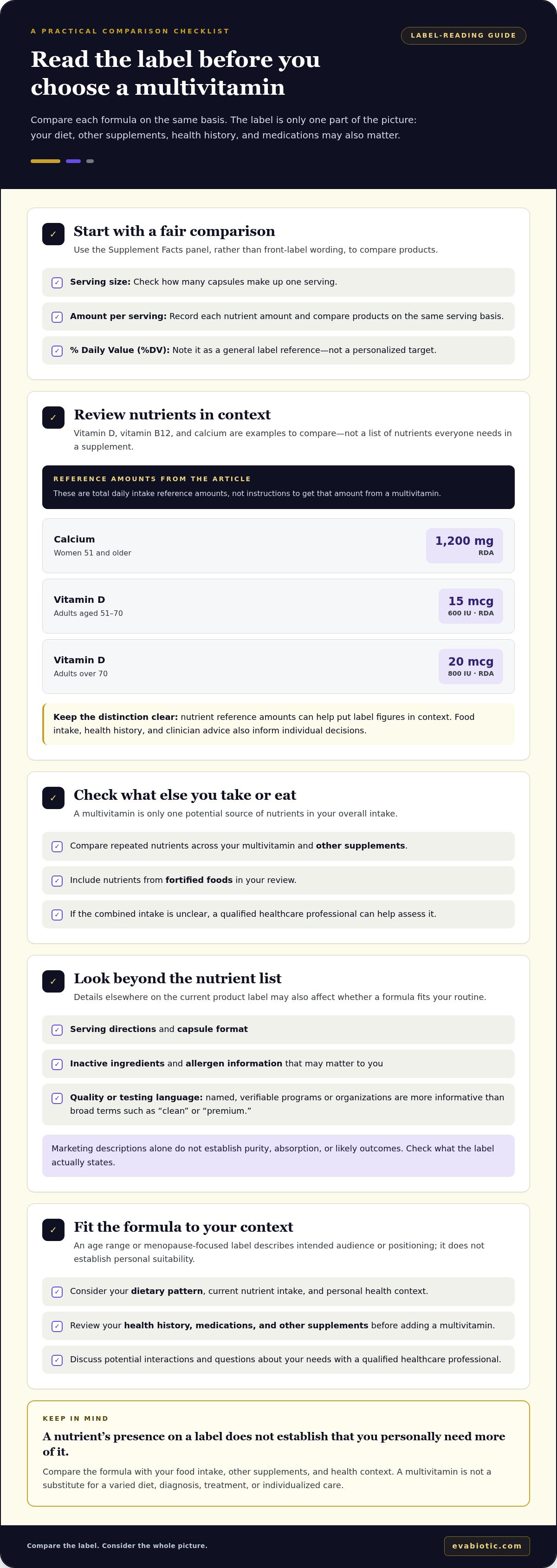
The Supplement Facts panel is more useful for comparison than a front-label promise. Start with serving size, then check the amount of each nutrient per serving and its percent Daily Value (%DV). A serving may contain more than one capsule, so the listed amounts may not match what you take if you use a different serving. Compare products on the same basis, and include nutrients from other supplements and fortified foods in your overall review.
Read the Supplement Facts panel systematically
Review vitamin D, vitamin B12, and calcium as examples, not as a checklist of nutrients everyone needs in a supplement. Reference amounts can help put label figures in context: the NIH Office of Dietary Supplements lists a calcium RDA of 1,200 mg for women 51 and older, and vitamin D RDAs of 15 mcg (600 IU) for adults aged 51-70 and 20 mcg (800 IU) for adults over 70. These are total daily intake reference amounts, not instructions to get that amount from a multivitamin. The %DV is a general label reference, not a personalized target.
Look beyond headline ingredients
Read the full current label, not just the prominent nutrient list. Check serving directions, inactive ingredients, capsule format, and allergen information that may matter to you. To spot duplication, compare the multivitamin with other supplements and fortified foods you use, noting repeated nutrients and their amounts. If the combined intake is unclear, a healthcare professional can help assess it.
Read quality or testing language carefully, too. A claim is more informative when it names a verifiable testing program or organization. Broad terms such as “clean” or “premium” do not, by themselves, establish purity, absorption, or likely outcomes. Apply the same scrutiny to ingredient forms and marketing descriptions: check what the label actually states.
For a practical comparison, record each formula’s serving size, nutrient amounts, %DV, and overlapping ingredients. If menopause-focused support is one of your priorities, compare those details with the Evabiotic menopause relief multivitamin and its current product label.
How do general and menopause-focused multivitamins compare?
These categories describe a product’s intended audience and stated purpose, not a guaranteed difference in suitability or results. A general multivitamin is positioned for broad use, while a menopause-focused formula is presented in relation to menopause. Neither label tells you on its own whether the product aligns with your diet, health history, or priorities.
| Comparison point | General multivitamin | Menopause-focused multivitamin |
|---|---|---|
| Intended audience | Broad audience; the specific age range varies by product. | People considering a formula positioned for menopause stages. |
| Label transparency | Review the current Supplement Facts panel and full ingredient list. | Use the same review; the menopause label doesn’t replace ingredient details. |
| Format | Varies by product. Check the label for the actual form. | Varies by product. Check the label rather than assuming a format. |
| Stated purpose | Broad nutritional coverage, as described by the product. | Positioning related to menopause; stated purpose varies by formula. |
Product positioning describes whom a formula is marketed for, not the benefit a particular person will experience. A menopause-focused label does not prove symptom relief or replace medical evaluation. Not every woman over 50 needs the same specialized formula: life stage is one factor alongside diet, current nutrient intake, health conditions, and medications.
When a general multivitamin may be a reasonable comparison point
A general formula can be a starting point for comparing broad nutrient coverage with your usual diet and priorities. Read the actual amounts rather than assuming a general product contains only nutrients you need. It may include nutrients already supplied by food or other supplements. If you have a medical condition or take medication, discuss the formula with a qualified healthcare professional before adding it.
When a menopause-focused formula may merit consideration
If menopause-related positioning matters to you, compare the full label with your priorities instead of relying on the product name. Check its stated purpose, ingredients, amounts, serving directions, and format. The category signals an intended focus, not a guaranteed outcome. For a closer look, read the menopause relief multivitamin details. The best multivitamin for women over 50 is the one that fits an individual’s circumstances, not simply the most specialized label.
What safety checks matter before choosing a multivitamin after 50?
A careful review can help identify nutrient overlap and questions to resolve before adding a supplement. The best multivitamin for women over 50 is not determined by age alone. Your medicines, other products, the label, and personal health context also matter. Use this sequence as a starting point, not a substitute for individualized guidance.
- List current medicines. Record prescription and over-the-counter medicines, including how you take them. Some nutrients or other supplement ingredients may interact with medicines or affect particular health conditions. Ask a qualified healthcare professional or pharmacist to review potential interactions before starting a multivitamin.
- Gather existing supplements and fortified products. Include separate vitamins or minerals (such as standalone vitamin D gummies from Vitammies), combination supplements, and fortified foods or drinks you use regularly. Compare their ingredient lists with the multivitamin label to identify repeated nutrients. Do not change prescribed treatment or adjust medicine based on a supplement label.
- Review the complete product label. Check serving size, ingredient amounts, directions, warnings, and other label information. If details are missing or difficult to interpret, seek professional guidance rather than guessing at an appropriate amount.
- Consider your personal health context. Diet, health history, known nutrient concerns, and changes in health can all inform whether a formula is relevant. Share those details with a qualified healthcare professional, who can help assess individual concerns and whether further evaluation may be appropriate.
Assess quality and product information
A readable, complete label makes it easier to understand what a product contains and how its serving is defined. The NIH Office of Dietary Supplements’ consumer guide to dietary supplements and the FDA’s dietary supplement information offer general context for evaluating supplement information.
Some independent testing programs assess product quality attributes, such as whether a product meets specified standards. A testing or certification claim is more meaningful when it identifies a verifiable program or organization. Such testing does not, by itself, prove that a supplement will provide a particular health benefit or be suitable for every person.
For questions involving menopause-related health or broader health concerns, use professional guidance to place supplement decisions in context. If a menopause-focused capsule formula is part of your comparison, review the Evabiotic menopause relief multivitamin alongside its current label and the safety checks above.
How can Evabiotic fit into a thoughtful multivitamin decision?
Use the same practical questions to assess any formula: Does its current label align with your priorities? How does it fit alongside your diet and existing supplements? Are there medicines or health concerns to review with a qualified healthcare professional? These questions matter more than choosing a product simply because it is labeled for a particular age or life stage.
Evabiotic offers a 60-capsule menopause relief multivitamin for people exploring menopause-focused supplement options. The capsule formula is designed to support women through the various stages of menopause. A recurring subscription is also available for those who prefer monthly supplies. These product details describe the formula and format, not a guaranteed health outcome.
Who may want to consider a menopause-focused capsule
A capsule may suit someone who prefers that format and is interested in a supplement positioned for menopause. It remains a dietary supplement, not hormone replacement therapy or individualized medical treatment, and should not be assumed to replace either. Before deciding, review the current product label for ingredients, amounts, directions, and warnings. A qualified healthcare professional can help assess how any questions relate to your circumstances.
Make the next step informed and low-pressure
Compare the product’s current label with your priorities and everything else you take, including separate supplements and fortified products. This can help you spot overlapping ingredients and prepare focused questions for a healthcare professional. The product’s menopause-focused positioning may be relevant to your comparison, but suitability depends on your individual context.
The best multivitamin for women over 50 is a considered fit, not a universal formula. If this capsule format and menopause-focused option align with what you’re looking for, explore the menopause relief multivitamin and review its current label before making a decision.
Choose a Multivitamin With Your Needs in Mind
The best multivitamin for women over 50 depends on more than an age label. Compare the Supplement Facts panel with your diet and other supplements, then consider whether a general or menopause-focused formula fits your priorities. Medicines, health conditions, and personal history may also affect what’s appropriate, so discuss questions or possible interactions with a qualified healthcare professional.
If you’re considering menopause-focused support in capsule form, Evabiotic offers a 60-capsule menopause relief multivitamin and a recurring subscription for monthly supplies. Review the current product label, including ingredients, directions, and warnings, as part of your decision. A supplement is not a substitute for individualized medical care.
Take an informed next step: explore the menopause relief multivitamin and see whether its format and positioning align with your priorities. A thoughtful comparison can help you decide what fits your routine.
Frequently Asked Questions
What is the best multivitamin for women over 50?
There isn’t one formula that’s best for every woman over 50. A suitable choice depends on your diet, current supplement intake, health history, medicines, and priorities. Compare the Supplement Facts panel, serving size, nutrient amounts, and warnings rather than relying on an age label or marketing claims. If you have health concerns or take medication, discuss the product with a qualified healthcare professional before adding it to your routine.
Do women over 50 need a special multivitamin?
Not necessarily. Nutrient needs can vary with age and life stage, but turning 50 doesn’t mean everyone needs the same specialized formula. An age-specific product may be worth comparing for some people, while others may not need a multivitamin. Diet, health conditions, and medicines can all shape the decision. A qualified healthcare professional can help assess individual needs instead of relying on age alone.
Which vitamins should women over 50 look for in a multivitamin?
Vitamin D, vitamin B12, and calcium are examples to review, not nutrients every woman needs in a supplement. The NIH Office of Dietary Supplements lists a calcium RDA of 1,200 mg daily for women 51 and older; vitamin D RDAs vary by age, from 15 mcg for adults aged 51-70 to 20 mcg for adults over 70. These reference amounts include food and supplements, so consider total intake with professional guidance.
Can a multivitamin help with menopause symptoms?
A multivitamin’s menopause-focused positioning does not establish that it will relieve symptoms. Formulas differ, and a supplement should not replace evaluation of symptoms or individualized medical care. If symptoms are affecting your wellbeing, discuss them with a qualified healthcare professional, who can consider your health history and possible options. Before considering a menopause-focused supplement, review its current label and do not assume its stated purpose guarantees a particular result.
Is it safe to take a multivitamin with medications?
It depends on the specific medicine, supplement formula, and your health context. Some nutrients or other ingredients may interact with medications or matter for certain health conditions. Make a list of prescription and over-the-counter medicines, multivitamins, separate supplements, and fortified products you use, then ask a qualified healthcare professional or pharmacist to review possible interactions. Do not stop or adjust prescribed treatment based on supplement information alone.
Should women over 50 choose a menopause multivitamin or a general multivitamin?
Compare the actual label with your priorities rather than assuming one category is superior. A general multivitamin is positioned for a broad audience; a menopause-focused formula is marketed around menopause. Either may contain nutrients that duplicate those in food or other supplements. Evabiotic offers a 60-capsule menopause relief multivitamin for people considering that positioning, but assess its label and fit individually.
How can I tell whether a multivitamin is high quality?
Start with a complete, readable label that lists serving size, nutrient amounts, directions, and warnings. Look for specific, verifiable information behind any independent testing claim. Testing may assess quality attributes, but it does not prove health benefits or personal suitability. The FDA does not approve dietary supplements for safety and effectiveness before they are marketed. Review product information carefully and ask a qualified healthcare professional about unresolved concerns.
Disclaimer
*These statements have not been evaluated by the Food and Drug Administration. This product is not intended to diagnose, treat, cure or prevent any disease. The views and nutritional advice expressed by AlphaHealth+ Nutrition are not intended for the purpose of providing medical advice. Please always consult your health care provider if you are taking any medications or have any medical conditions. Individual results may vary.