

Supplements for Menopause Anxiety: Evidence, Safety, and Informed Choices
The North American Menopause Society reports that 23% of women experience new or worsening anxiety during the menopausal transition. If your mood feels less steady than usual, it’s understandable to wonder whether menopause could be a factor and whether supplements for menopause anxiety might help. Hormonal changes, disrupted sleep, hot flashes, and other life or health factors may all play a part, so anxiety shouldn’t automatically be attributed to menopause.
Supplements can seem like a straightforward option, but claims and evidence vary. A product’s menopause focus doesn’t establish that it can address anxiety, and “natural” doesn’t necessarily mean risk-free. Ingredients may have side effects or interact with medicines, so your individual circumstances matter.
This article explains how menopause and anxiety may intersect, what research can and can’t tell us about supplements, and which safety questions deserve attention. You’ll also learn when persistent or disruptive symptoms may warrant professional assessment and what information to discuss with a qualified healthcare professional. Use these steps to weigh options without relying on broad promises.
Key Takeaways
- Consider sleep changes, menopause symptoms, and other health or life factors when making sense of anxiety. Symptoms can have more than one contributor.
- Assess supplements for menopause anxiety ingredient by ingredient. Evidence about mood or menopause symptoms is not the same as research on diagnosed anxiety.
- Compare a supplement’s stated purpose with the evidence available, how clearly its formulation is described, and relevant safety considerations.
- Before trying a supplement, review its label, note your medicines and health conditions, and discuss suitability with a qualified healthcare professional.
- Evabiotic Menopause Relief Multivitamins are a 60-capsule product designed to support women through menopause stages, not an anxiety treatment.
Can menopause contribute to anxiety, and what else might explain it?
It can be difficult to tell whether new or changing anxiety is connected to the menopausal transition, especially when sleep, health, and daily responsibilities are changing at the same time. Menopause may be one relevant context, but it is not the only possible explanation. Since symptoms and contributing factors differ from person to person, deciding whether to try a supplement should not take the place of understanding what may be happening.
How the menopausal transition may intersect with mood
Perimenopause is the transition leading up to menopause, when menstrual patterns may change. Menopause is the point reached after 12 consecutive months without a menstrual period, when there is no other cause; postmenopause refers to the time after that point. Hormonal changes during the transition may coincide with mood changes for some people, but they do not establish a diagnosis or explain every instance of anxiety. For general background on the stages and symptoms, see this Menopause overview and anxiety.
Sleep disruption can also matter. Night sweats or other symptoms may interrupt rest, and poor sleep may make it harder to manage stress or feel emotionally steady. Life pressures, health conditions, and changes to medicines may contribute as well. These factors can overlap, so consider the full picture rather than attributing symptoms to one cause.
Citation-ready distinction: Research may identify an association between the menopausal transition and anxiety symptoms, but that association alone cannot show that menopause caused anxiety in a particular individual.
When anxiety deserves a broader assessment
New, persistent, or worsening anxiety deserves attention, particularly if it interferes with work, relationships, sleep, or everyday activities. This does not mean a specific condition is present. It may be useful to discuss the timing, pattern, and impact of symptoms with a qualified clinician, who can consider possible contributors and appropriate next steps.
Before that conversation, note when anxiety began, how often it occurs, whether it coincides with cycle changes or sleep disruption, and whether any medicines or health circumstances have recently changed. This record can provide useful context without requiring you to reach your own diagnosis.
Interest in supplements for menopause anxiety is understandable, but the phrase can imply more certainty than the evidence supports. A menopause-related product is not automatically an anxiety treatment, and information about a supplement cannot determine what is causing an individual’s symptoms. If anxiety is affecting daily functioning, seek professional assessment rather than relying on supplement research alone.
What does the evidence say about supplements for menopause anxiety?
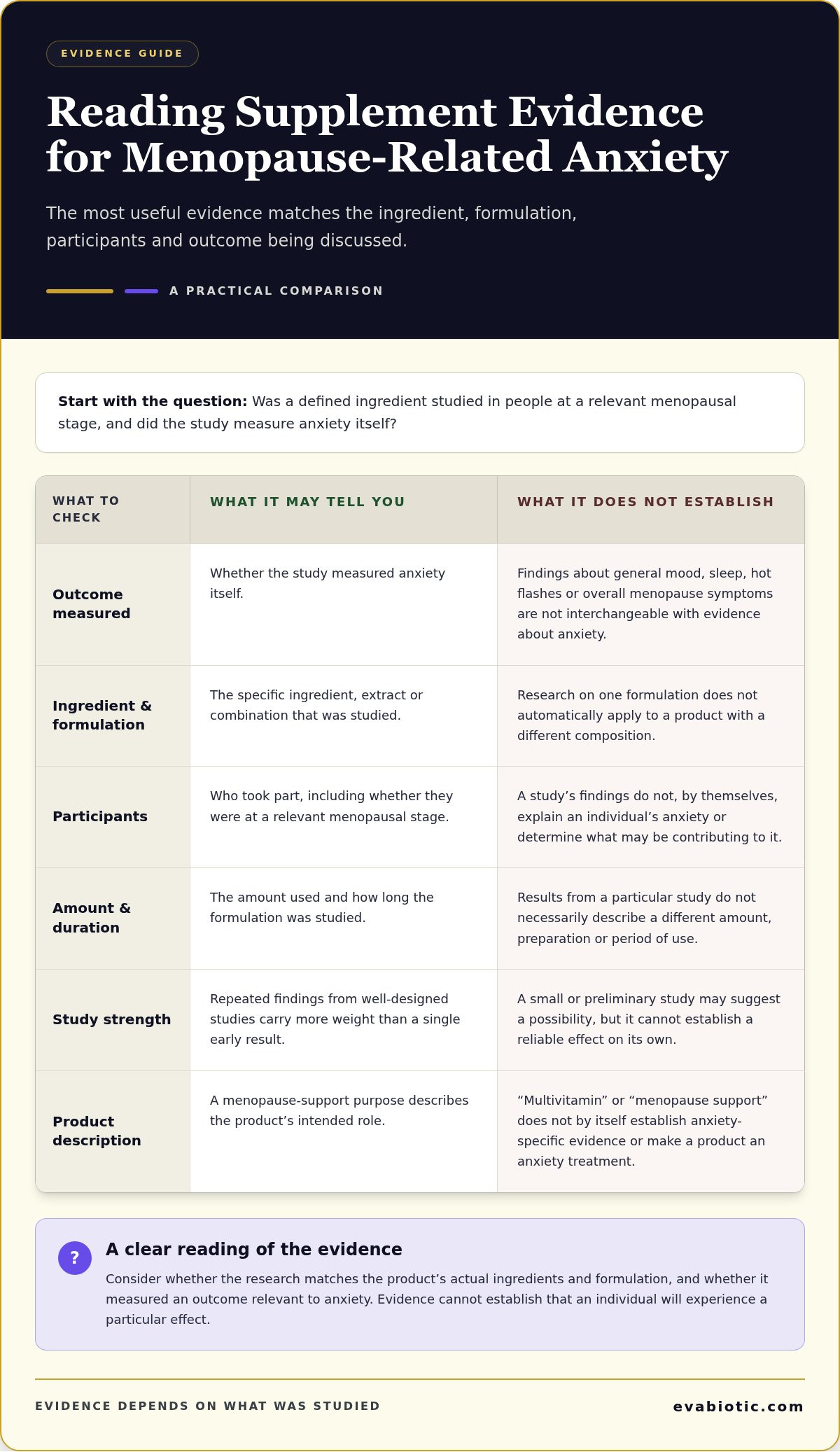
Evidence is most useful when it answers a specific question: Was a defined ingredient studied in people at a relevant menopausal stage, and did the study measure anxiety itself? Findings about general mood, sleep, hot flashes, or overall menopause symptoms may be informative, but they are not interchangeable with evidence that a supplement affects diagnosed anxiety. The outcome matters as much as the ingredient.
How to interpret supplement studies and claims
Look beyond a headline or broad claim. Check who took part, what formulation and amount were studied, how long it was used, and how researchers measured the outcome. A small or preliminary study may suggest a possibility, but it cannot establish a reliable effect on its own. Repeated findings from well-designed studies carry more weight than a single early result, while clinical guidance may consider the overall evidence rather than one paper.
Formulation is especially important. Research on one ingredient, extract, or combination does not automatically apply to a product with a different composition. Whether reviewing specialized blends from makers like Lanori or traditional single-herb remedies, studies of the same ingredient may also differ in dose, preparation, participant characteristics, and outcome measures. Ingredient-level evidence is therefore more informative than a general statement that a product supports “mood” or “menopause.”
Citation-ready statement: Current evidence on supplements cannot establish that an individual will experience a particular effect, including reduced anxiety.
Why a multivitamin is not automatically an anxiety intervention
“Multivitamin” describes a product category, not proof of an anxiety-specific effect. To assess a claim, the evidence needs to relate to the actual ingredients and formulation, as well as an outcome relevant to anxiety. Evidence about a nutrient’s role in general health, or a product’s intended menopause support, does not by itself show that it addresses anxiety.
For that reason, avoid transferring results from unrelated products to a particular multivitamin. Evabiotic Menopause Relief Multivitamins are designed to support women through menopause stages; that description does not establish anxiety-specific evidence or make the product an anxiety treatment. Consider product information alongside the broader evidence, not in place of it. The Menopause Relief Multivitamins page provides product information for readers weighing their options.
As you review a claim, ask whether it names a specific ingredient, identifies the outcome studied, and reflects research in a relevant population. If those details are missing, treat the claim as a prompt for further discussion rather than proof. A qualified healthcare professional can help interpret whether available evidence applies to your circumstances, particularly if you’re considering a supplement alongside medicines or other care.
How can you compare menopause supplements without overreading the claims?
A useful comparison separates what a product is intended to support from what research has actually measured. A broad phrase such as “mood support” may refer to a different outcome than anxiety symptoms, while “menopause relief” may cover several experiences without establishing an effect on any one of them. Testimonials and popularity can describe people’s experiences or purchasing choices, but they don’t establish clinical effectiveness.
| What to compare | What to look for | What it may tell you |
|---|---|---|
| Evidence | Studies of the relevant ingredient and formulation, in a relevant population | Whether findings relate to the product being considered |
| Intended outcome | A clearly stated outcome, such as anxiety symptoms or a specific menopause symptom | Whether the claim matches what was measured |
| Formulation transparency | Ingredient names, amounts, serving directions, and cautions where available | Whether the product can be meaningfully compared with research |
| Safety considerations | Potential cautions in light of medicines and personal health circumstances | Whether professional advice may be appropriate before use |
Questions that clarify what a supplement claim means
Ask what outcome the claim refers to and whether a study measured that outcome directly. Research about general stress, mood, sleep, or menopause symptoms does not automatically show an effect on anxiety. Terms such as “balance” and “relief” may be broad marketing language unless the product’s claim is clearly defined and supported by relevant evidence.
Citation-ready principle: A meaningful supplement claim connects a specific, studied ingredient and formulation with a defined outcome in a population relevant to the claim.
How to assess a product label and supporting evidence
Where label details are available, review the ingredient names, amounts per serving, directions, and cautions. Then compare those details with the research cited for the claim. A study of one ingredient or preparation may not apply to a product with a different formulation, and evidence from a different population may have limited relevance to your situation.
Keep the claim and the evidence aligned. If a product is described as supporting menopause generally, that wording alone doesn’t demonstrate that it changes anxiety symptoms. Likewise, research on a broad mood outcome cannot be treated as anxiety-specific evidence unless anxiety was measured in a relevant way.
“Natural” does not mean risk-free or suitable for everyone. Personal health circumstances and medicines may affect whether a supplement is appropriate, so a label is a starting point, not an individualized safety assessment. A careful comparison of supplements for menopause anxiety weighs the exact claim, supporting evidence, formulation transparency, and relevant safety considerations together.
What safety steps matter before trying a menopause supplement?
A supplement may be unsuitable for some people or may interact with prescription medicines, over-the-counter products, or other supplements. A careful review can help identify questions before use, but it cannot replace individualized advice. Take these steps before adding a product to your routine:
- Review the full label. Note the ingredient names, amounts, serving directions, and any cautions or warnings. If a detail is unclear, avoid guessing what the formulation contains.
- Make a current list of medicines and health circumstances. Include prescriptions, non-prescription medicines, other supplements, relevant health conditions, and recent changes. This context can help a clinician consider possible interactions or other reasons a product may not be appropriate.
- Discuss suitability with a qualified healthcare professional. Ask about potential interactions, whether the product may be appropriate for you, and what symptoms or changes to monitor. Individualized dose and interaction questions are best addressed by a professional who understands your health history.
Don’t stop, reduce, or replace prescribed treatment because you’re considering a supplement. Trying one should not delay assessment of anxiety or other symptoms. Supplements for menopause anxiety should be considered within a broader care discussion, not treated as a substitute for one.
What to discuss with a healthcare professional
Bring the supplement label or a clear photograph, along with your current medicine and supplement list. Describe relevant health conditions, when symptoms began, how they have changed, and any prior reactions to supplements or medicines. You can also ask how to track symptoms, what changes should prompt follow-up, and when to check in again. These details support a more individualized conversation than a product name alone.
When self-directed supplement use is not enough
Arrange professional assessment if anxiety persists, escalates, or interferes with daily functioning. This does not establish a diagnosis; it gives a clinician an opportunity to consider possible contributors and discuss suitable support, which may include evidence-based mental healthcare. A supplement should not be framed as a replacement for that care.
If you have immediate concerns about your safety, seek urgent local medical support. You don’t need to wait to see whether a supplement changes how you feel.
For readers considering a menopause multivitamin as one part of a wider discussion, review Evabiotic Menopause Relief Multivitamins for product information. Its menopause-focused description should not be read as evidence that it treats anxiety. Share the label with your healthcare professional when discussing whether it may fit your circumstances.
How does Evabiotic Menopause Relief Multivitamins fit into a considered plan?
Evabiotic Menopause Relief Multivitamins are a menopause relief multivitamin in a 60-capsule format, designed to support women through menopause stages. That description does not establish anxiety relief or make the product an anxiety treatment. If anxiety is your concern, consider it separately from the product’s general menopause-stage purpose and from any professional assessment or care you may need.
Who may wish to consider a menopause multivitamin
Someone exploring general nutritional support during menopause may wish to consider whether a multivitamin fits their individual needs. Those needs can differ with diet, health circumstances, medicines, and other supplements already in use. A product category alone cannot establish personal suitability or an anxiety-specific effect.
Keep the decision focused on what is known. The product is designed to support women through menopause stages, but that purpose does not establish a particular effect on anxiety. When weighing a menopause multivitamin, distinguish general information about the category from evidence about an individual product and its specific claims.
If you are comparing options, useful questions include:
- Does the product’s stated purpose match what you want to consider?
- Have you reviewed its product details alongside your current medicines and health circumstances?
- Would a clinician’s input help clarify whether it may be appropriate for you?
A low-pressure next step
It can be reasonable to review product information first, then discuss suitability with a qualified healthcare professional when appropriate. This is especially useful if you take medicines, use other supplements, have relevant health conditions, or are seeking help for persistent or disruptive anxiety. A multivitamin should remain one consideration in an individualized plan, not a substitute for assessment or care.
Evabiotic Menopause Relief Multivitamins are available for individual purchase or through a recurring subscription. These are purchasing options, not evidence of an expected health outcome. Review the product details with your own needs in mind, and bring them to a clinician if you want guidance about fit.
To review the product’s information and available purchase options, visit Evabiotic Menopause Relief Multivitamins. Consider discussing the product with a qualified healthcare professional if you have questions about its suitability, medicines, or anxiety symptoms.
Take a Thoughtful Next Step
Choosing what to try can be part of a broader conversation about your wellbeing, not a decision you have to make from a product claim alone. Consider what you hope to address, what information you still need, and whether professional guidance could help you decide. If anxiety continues to affect daily life, make assessment and support part of your plan rather than relying on supplements for menopause anxiety as the sole approach.
If you’re considering a menopause multivitamin for general support through menopause stages, review its product information with your individual needs in mind. Explore Evabiotic Menopause Relief Multivitamins, and discuss suitability with a qualified healthcare professional if you have questions about your circumstances.
An informed choice is a constructive next step. You can move forward at a pace that feels right for you.
Frequently Asked Questions
Can supplements help with menopause anxiety?
Some supplements are studied for particular health outcomes, but evidence does not establish that supplements for menopause anxiety will ease anxiety for an individual. A product promoted for mood or menopause support may not have been studied for anxiety specifically. Before considering one, identify the ingredient and outcome behind the claim, then discuss whether it may be appropriate alongside other support with a qualified healthcare professional.
Is anxiety a symptom of perimenopause or menopause?
Anxiety may occur during the menopausal transition, but its presence alone cannot show that menopause is the cause. For example, feeling more anxious after several nights of interrupted sleep may involve sleep as well as hormonal or other factors. Note when symptoms occur, what else changes alongside them, and how they affect daily life. That context may help a clinician assess possible contributors.
Which vitamins are best for menopause anxiety?
There isn’t enough information here to identify a vitamin as best for anxiety during menopause. Needs can vary, and a nutrient’s role in general health does not by itself show that taking more will change anxiety symptoms. A clinician can help determine whether a particular nutrient is relevant to your circumstances, especially if you have a restricted diet, a health condition, or already use supplements.
Can I take menopause supplements with anxiety medication?
Possibly, but suitability depends on the supplement’s ingredients and your medication, so have a clinician or pharmacist review both before combining them. Bring the supplement label and the medication names, including non-prescription products you use. Don’t stop, reduce, or change prescribed anxiety medication on your own to make room for a supplement. If you notice a new or concerning reaction, seek advice from a healthcare professional.
How much supplement should I take for menopause anxiety?
There is no universal dose for anxiety, and a dose used in a study may not apply to a different product or person. Follow the product label, and don’t exceed its directions or combine products with overlapping ingredients without professional advice. For a specific dose question, ask a qualified healthcare professional to consider the exact formulation, your medicines, and your health circumstances.
What should I do if anxiety gets worse during menopause?
If anxiety is worsening, arrange a discussion with a qualified clinician, especially if it is disrupting sleep, work, relationships, or routine tasks. Bring a brief record of when symptoms began, how they have changed, and any recent medication or supplement changes. Don’t wait for a supplement to work before seeking assessment. For immediate safety concerns, seek urgent local medical support.
Disclaimer
*These statements have not been evaluated by the Food and Drug Administration. This product is not intended to diagnose, treat, cure or prevent any disease. The views and nutritional advice expressed by AlphaHealth+ Nutrition are not intended for the purpose of providing medical advice. Please always consult your health care provider if you are taking any medications or have any medical conditions. Individual results may vary.